
Hearing in Dogs

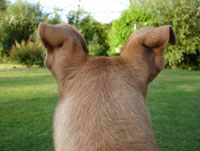
A dog’s sense of hearing is second only to his sense of smell in terms of superior ability and discernment. Dogs don't have the best eyesight, but they can compensate with their other senses.
In What Way Is Dog Hearing Better than Human Hearing?
Dogs hear a wider range of frequencies than humans. Human hearing can detect sounds beginning at 20 hertz and ranging up to 12,000-20,000 hertz, depending on age. However dogs can hear in the range of 40-60,000 hertz, depending on breed and age. Dogs and humans both lose some ability to hear higher frequencies as they get older. Higher frequencies equate to a higher-pitched noise. For example, a dog whistle produces sound between 16,000 and 22,000 hertz. This is out of range for the hearing of most humans but in the middle of the range of dog hearing.

The Anatomy of a Dog's Ears
The anatomy of the middle and inner ear is relatively the same in humans and dogs. Both have an eardrum, or tympanic membrane. Both species also have ossicles, or little bones in the inner ear that vibrate and send signals along the auditory nerve to the brain. The real key to better hearing in dogs is the 18 or more muscles that control a dog’s pinna, or ear flap. These numerous muscles allow a dog to finely tune the position of his ear canal to localize a sound, hear it more accurately, and from farther away. For this reason, dogs with upright ears, such as terriers, tend to have superior hearing to dogs with floppy ears, such as hounds. It also means that dogs are much more sensitive to loud noises than are humans. Loud noises that are tolerated by humans may be scary or even painful to dogs.
Interestingly, dogs are born deaf, with closed ear canals. Most puppies’ ear canals will open by 10-14 days after birth. If a dog does not seem to hear by 3 weeks of age, he should be tested for deafness by a veterinarian.
Figure 1 illustrates typical canine ear anatomy. Note the long horizontal ear canal.
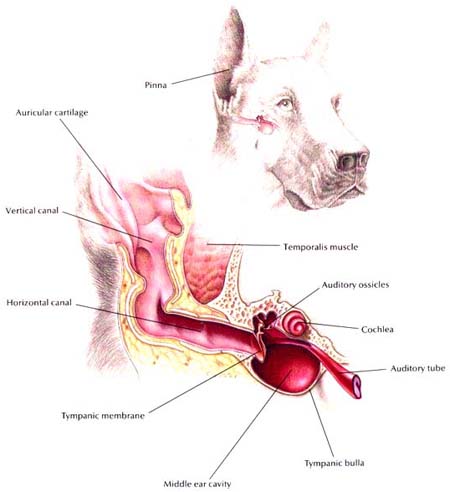
The picture in this section is reprinted with permission by the copyright owner, Hill's Pet Nutrition, from the Atlas of Veterinary Clinical Anatomy. This illustration should not be downloaded, printed or copied except for personal, non-commercial use.

You May Also Like These Articles:
Otitis Externa: Ear Infections in Dogs
Foxtails: A Summertime Hazard for Dogs
Disclaimer: This website is not intended to replace professional consultation, diagnosis, or treatment by a licensed veterinarian. If you require any veterinary related advice, contact your veterinarian promptly. Information at DogHealth.com is exclusively of a general reference nature. Do not disregard veterinary advice or delay treatment as a result of accessing information at this site. Just Answer is an external service not affiliated with DogHealth.com.
